
Key Takeaways
- High-speed Maryland truck crashes frequently cause “occult” (hidden) spinal cord injuries that emergency room physicians at facilities like University of Maryland Shock Trauma and Johns Hopkins Hospital sometimes miss.
- A misdiagnosis after a truck wreck can create two separate claims: one against the trucking company for causing the collision and another against the hospital for medical malpractice.
- Non-economic damages in Maryland for medical malpractice victims are capped at $890,000, with an annual increase of $15,000, while wrongful death cases with two or more beneficiaries are capped at $1,150,000—but economic damages like costs for additional medical treatment, lost wages, and expenses related to the initial emergency room visit remain uncapped.
- Claims seeking over $30,000 in Maryland must first be filed as a lawsuit with the Health Care Alternative Dispute Resolution Office (HCADRO) for mandatory arbitration before proceeding to circuit court.
- Maryland law requires a Certificate of Merit from a qualified expert within 90 days of filing a malpractice claim.
- Call Snyder Law Group LLC at (410) 936-5288 (410-The-Firm) for a free case evaluation and free consultation, including an ER-record review.
The Intersection of High-Speed Trucking Collisions and ER Negligence
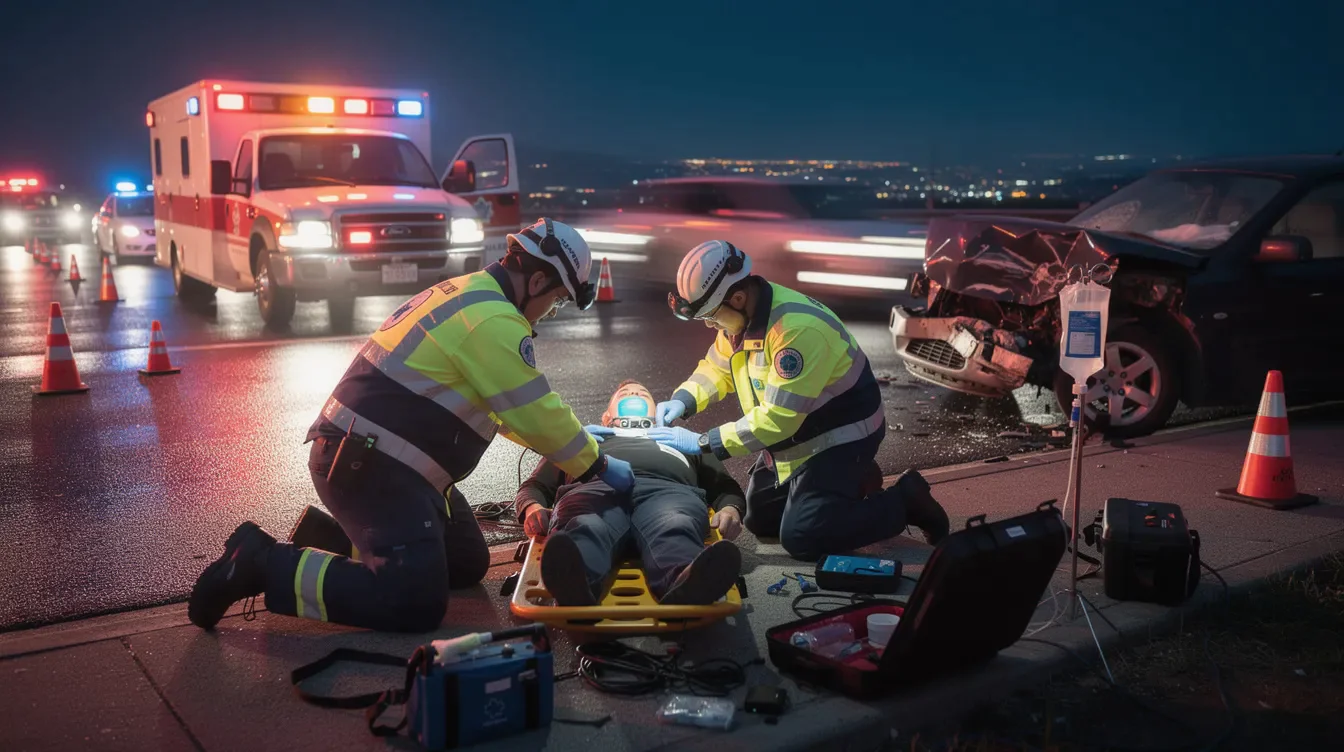 A fully loaded 80,000-lb semi-truck traveling at interstate speeds on I-95 or the Baltimore Beltway in the Baltimore area generates massive kinetic energy upon impact. This force makes spinal trauma a medically foreseeable risk that every emergency room physician should actively rule out. Spinal cord injury is a common and serious outcome of such accidents, often resulting in significant and lasting health challenges.
After Maryland truck wrecks, injured patients are commonly transported to regional trauma centers like University of Maryland Shock Trauma Center, Johns Hopkins Hospital, or MedStar Washington Hospital Center for Prince George’s County crashes. These collisions frequently cause occult spinal injuries—micro-fractures, disc herniations, ligamentous instability, and spinal cord contusions—that may not appear on initial X-rays or incomplete neurological exams. Missed or delayed diagnosis of these injuries can lead to life altering consequences, such as permanent disability, chronic pain, or diminished quality of life.
The Maryland standard of care requires ER doctors to affirmatively rule out spinal injury in high-impact collisions, not simply treat visible wounds and discharge the patient. Diagnosis and treatment must be provided in a timely manner to prevent further harm. Rear-end underride collisions typically cause cervical spine injuries, while side-impacts from tractor-trailers often damage thoracic and lumbar vertebrae. Snyder Law Group LLC routinely litigates both the trucking negligence case and the subsequent ER misdiagnosis case as a coordinated “hybrid” claim. Their team includes Baltimore medical malpractice attorneys and skilled medical malpractice attorneys with extensive experience in handling these complex cases. These medical malpractice attorneys are dedicated to representing victims of catastrophic injuries in the Baltimore area. Consulting a medical malpractice lawyer is crucial to navigate the complexities of misdiagnosis and truck accident claims in Maryland, ensuring that victims receive the specialized legal guidance they need.
Common Red Flags ER Doctors Miss After a Commercial Collision
Hectic emergency departments can mislabel serious spine symptoms as “whiplash” or general soreness, especially when the patient is alert and ambulatory. The emergency room physician and other medical staff, including nurses and other health care providers, may overlook subtle neurological signs in truck-crash victims that should trigger immediate medical evaluation and advanced imaging. These collisions frequently cause occult spinal injuries and other serious medical conditions or illnesses that may be misdiagnosed, resulting in premature discharge and later paralysis, chronic pain, or loss of bowel control.
It is critical for ER doctors to affirmatively rule out spinal injury and to avoid prescribing the wrong medication or misdiagnosing other illnesses. Medical professionals have a duty to provide reasonable care in diagnosing and treating patients. Accurate diagnosis of an illness is essential for effective treatment, as missed or incorrect identification can lead to delayed care, worsening of the illness, unnecessary procedures, or even life-threatening complications. Failure by medical staff, including nurses, to properly diagnose or treat these medical conditions can lead to severe consequences for the plaintiff. Plaintiffs in medical malpractice cases often suffer complications, additional suffering, or even untimely death due to misdiagnoses, which are the most commonly claimed complaint.
Clients who have suffered harm from misdiagnosis or delayed diagnosis should consider consulting an experienced attorney to guide them in pursuing medical malpractice claims and to ensure their rights are protected.
Radicular Pain and Numbness vs. “General Soreness”
Radicular symptoms—sharp, shooting pain, numbness, or weakness radiating down an arm or leg—indicate possible nerve root or spinal cord involvement. ER physicians breach the standard of care when they dismiss these signs as muscle strain without performing a complete neurological exam documenting reflexes, strength, sensation, and gait.
Common missteps include ignoring foot drop, dismissing saddle anesthesia (a medical emergency indicating cauda equina syndrome), and failing to order MRI when CT scans appear “normal” but symptoms persist. Snyder Law Group’s review of medical records often reveals that triage notes documented radicular pain but discharge summaries never addressed it.
Failure to Diagnose Spinal Fractures and Compression
Axial loading, hyperflexion, and hyperextension forces in semi-truck collisions can cause vertebral fractures, burst fractures, and disc herniations that compress the spinal cord. Diagnostic failures include reliance on plain X-rays alone, misinterpretation of CT scans, and inadequate spine immobilization while awaiting imaging.
In Maryland medical malpractice cases, Snyder Law Group frequently uses board-certified neuroradiologists to demonstrate that concerning findings—canal narrowing, retropulsed bone fragments—were overlooked. Progressive spinal cord compression can turn a potentially reversible injury into permanent paralysis if decompression surgery is delayed due to failure to accurately diagnose the condition. Victims of such misdiagnosis may be entitled to recover compensation for both economic losses, like medical expenses and lost wages, and non-economic harm, including pain, suffering, and mental trauma resulting from negligent diagnosis or treatment failure.
The Dangers of “Discharge Too Early” Without Specialist Consultation
Early discharge after a violent truck collision—without a neurosurgeon or spine specialist consult—can constitute clear deviation from the Maryland ER standard of care when red flags exist. Common scenarios include normal vital signs but persistent spinal pain, negative CT without MRI, and instructions to simply “follow up with your primary care doctor.”
Occult spinal instability may worsen over 24–72 hours. An injured person who walked out of the ER can experience profound weakness or paralysis days later due to undiagnosed cord compression or epidural hematoma. Snyder Law Group often proves negligence in medical malpractice cases by establishing the defendant’s fault—demonstrating that the healthcare provider’s breach of the standard of care, such as premature discharge and missed red flags, directly caused injury or worsened the patient’s condition. This approach contrasts the ER’s rushed discharge decision with later inpatient records showing clear signs that should have prompted legal action during the initial visit.
Proving Medical Malpractice in Maryland: The Standard of Care
The standard of care in Maryland defines what a reasonably competent ER physician would have done when treating a high-speed truck-collision victim with possible spinal trauma. Proving misdiagnosis requires showing the ER doctor breached this standard and establishing the defendant’s fault through evidence and expert testimony (incomplete neurological exam, failure to order MRI) and that this breach caused a worse outcome for the injured patients.
Maryland medical malpractice lawsuits must typically begin in the Health Care Alternative Dispute Resolution Office, where the plaintiff must present evidence of the defendant’s fault. Procedural rules are strictly enforced in Baltimore City, Baltimore County, and surrounding jurisdictions.
The Certificate of Merit requirement is critical: Maryland law mandates that the plaintiff file the lawsuit and submit a sworn statement from a qualified expert—an emergency physician, neurosurgeon, or neuroradiologist—certifying that the health care providers breached the standard of care and caused harm. This certificate must be filed within 90 days of filing the claim. Missing this deadline can result in dismissal.
Under Maryland law, medical malpractice claims must generally be filed within five years of the injury or three years from discovery, whichever occurs first. Snyder Law Group assembles a team of medical professionals—ER doctors, spine surgeons, rehabilitation specialists—to connect the truck collision, ER negligence, and long-term spinal cord disability.
Maryland’s 2026 Medical Malpractice Damage Caps
Maryland limits non economic damages (pain, suffering, emotional distress) in medical malpractice cases but places no cap on economic damages such as medical bills, future care, and lost income.
| Claim Type | 2026 Noneconomic Cap | |
|---|---|---|
| Individual medical malpractice | $920,000 | |
| Wrongful death (2+ beneficiaries) | $1,150,000 | |
| Economic damages | Uncapped | |
| For catastrophic injuries like paralysis, lifetime costs—home modifications, wheelchairs, attendant care, lost wages—can exceed millions of dollars, all fully recoverable as economic damages. Understanding which cap applies to each portion of a hybrid claim is crucial to maximizing total compensation. | ||
In wrongful death cases involving untimely death from misdiagnosed spinal injuries, the higher $1,150,000 cap applies when multiple beneficiaries (spouse and children) pursue medical malpractice claims. Snyder Law Group structures pleadings and jury instructions to preserve every available category of damages under current Maryland law, helping victims recover damages and seek damages they deserve.
Why 410-THE-FIRM is Built for Complex “Hybrid” Claims
Snyder Law Group LLC regularly handles large commercial truck crashes and high-stakes medical malpractice, giving the firm a unique advantage when both types of negligence converge. The “hybrid” claim addresses two negligent acts: the truck driver